

Dear readers,
The always-helpful team at the left-wing pressure group Revolving Door Project put together a visual guide to the connections among the “mysterious bunch” who would be attending this week’s Abundance 2025 conference in Washington, D.C. “There's some real evil people involved with this,” alleges Revolving Door researcher Henry Burke.
The dossier entry about me is disappointingly brief — they don’t even mention that I was once a Charles G. Koch Summer Fellow interning at Americans for Tax Reform! — but one bit of dirt they did find on me was that I have “encouraged Republicans to embrace abundance.” Guilty as charged! As I wrote in January, I do want Republicans to support policies I support, especially when they run the government, and as such I was pleased to see quite a few Republicans and conservatives at the conference.
They weren’t out of place at the Abundance conference. Yes, Abundance, the book, written by liberals Ezra Klein and Derek Thompson, espouses a vision of abundance that is premised on liberal values, and primarily aims to influence intra-coalitional policy arguments among liberals and Democrats. But abundance, the concept, does not belong to Klein and Thompson (or anyone else). And because abundance, the policy project, aims to alleviate scarcities that matter to conservatives and liberals — like our insufficient production of housing and energy — it presents a great opportunity for conservatives and liberals to work together.
So Abundance 2025 was a broad church. It was produced by a coalition of policy organizations associated with the center-left (like the Niskanen Center, Inclusive Abundance, YIMBY Action and Employ America) and also the center-right (like the Foundation for American Innovation, the R Street Institute, the American Conservation Coalition and the Institute for Progress). And there was a lot of talk about bipartisan approaches to serve the shared goal of making American life more abundant.
One obvious question is: Is this a silly project, in the current environment, with Donald Trump as president?
Rep. Scott Peters, a Democrat from San Diego, appeared to personally struggle with that question during a joint interview on Thursday with Rep. Brett Guthrie, a Republican from Kentucky. Peters and Guthrie are both leaders on permitting reform — a policy project aimed at making it easier to produce and transmit energy — and while they had disagreements on policy and priorities, they also found a lot of common ground and sketched out ideas for how the parties could craft a shared, pro-energy permitting policy.
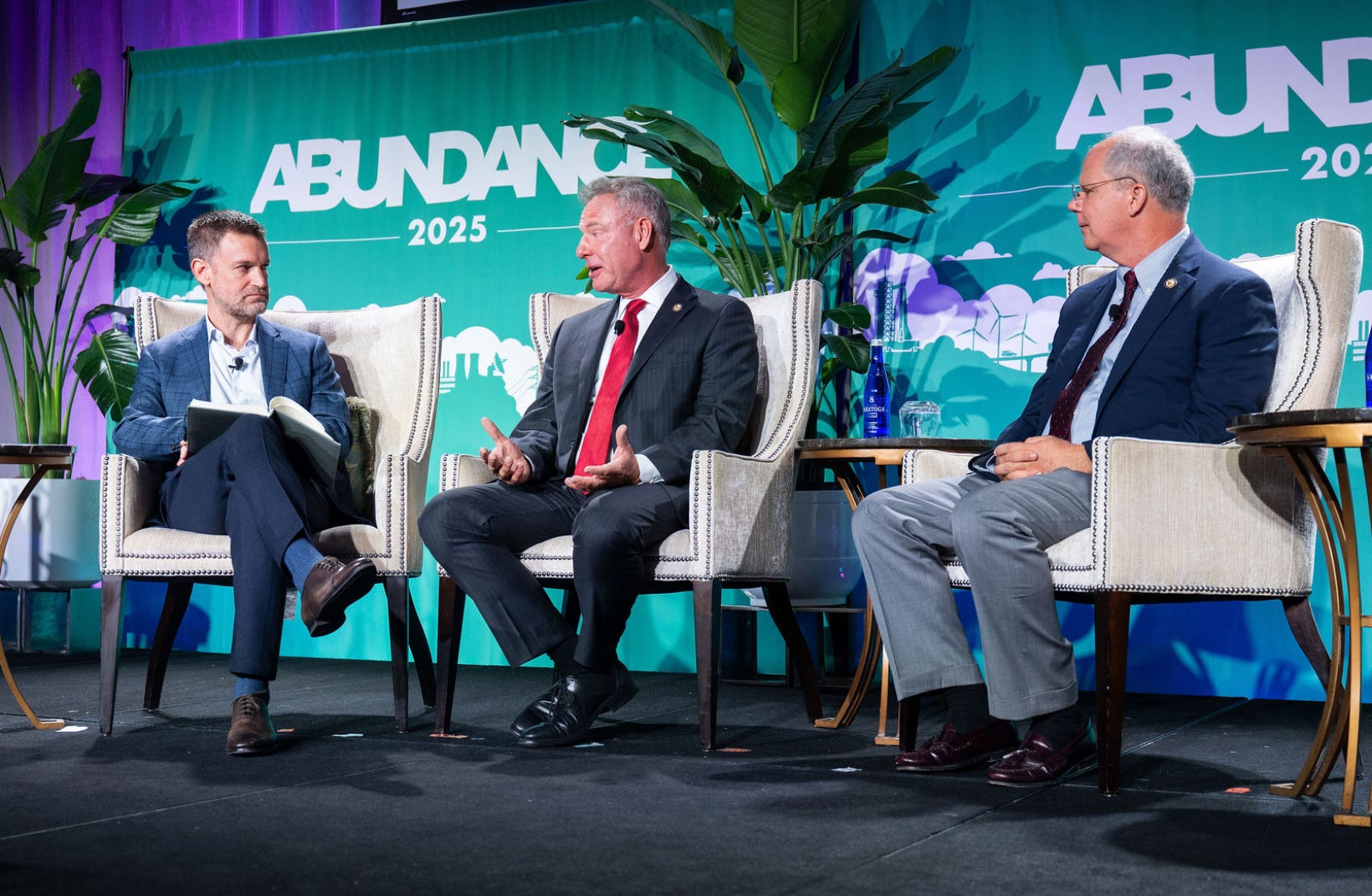
But Peters would occasionally become exasperated as anti-abundance aspects of Trump’s energy policy would occur to him. The president has ordered utilities to continue operating uneconomic coal plants, allowing them to pass on the cost of doing so to ratepayers across regions. He’s created new procedural barriers, requiring the Secretary of the Interior to personally approve all new solar and wind projects on federal land. He’s trying to revoke the permits for already-approved wind projects — not only depriving Americans of new electrical generation, but making it harder for investors to confidently put money toward future energy investments. (Energy investors now view us like “Vietnam or Brazil” — countries with emerging economies and poor rule of law — Peters remarked.)
Every time Peters brought up one of these actions, he lost some equanimity, as though the looming presence of Trump were physically intruding on the conversation he was trying to have with the normal-enough Republican sitting next to him. I can relate — the Trump presidency often makes me wonder what the point of talking about policy even is, too. But ultimately, Peters expressed the serenity to accept the things he cannot change and the courage to change the things he can. Peters believes they have the ability to work out something sensible in the Capitol building. What will happen at the other end of Pennsylvania Avenue, he can’t speak to.
There are two problems with Trump as a partner for abundance. One is that he has a scarcity mindset: he appears to be unable to conceive of a positive-sum transaction, and many of his policies (especially on trade and immigration) appear designed to hamper the production of housing and other capital. The other is that he is mercurial and untrustworthy. But the cross-aisle conversation still isn’t silly, for a few reasons.
The first is that Trump isn’t going to be around forever. The need to build interstate transmission lines and pipelines, to build more homes and more power plants, to encourage scientific developments and harness artificial intelligence — these are all projects that will be with us for decades and that require new legal frameworks. In four years, we’ll still have the policy architecture we build now, and we won’t be dealing specifically with Trump anymore. If the economy continues to slump in response to his policies, there might even be an emerging consensus that his scarcity mindset is a political loser.
The second is that a lot of the relevant policy fights are happening at the state level. Many of the successful efforts to produce abundance-related policy have been bipartisan, especially on housing, and state lawmakers came to the conference to share useful lessons. One was that housing proponents need to work across the aisle, because opponents of housing also sit on both sides of the aisle. Even in states where one party controls the government, votes from the minority party are often essential to passing housing reforms.
The third is that Republicans have lessons to teach Democrats, and vice versa. A lot of the “everything bagel” problems that plagued Biden-era investments in infrastructure arose because of liberals’ pathological need to cram unrelated coalition-management goals into bills that should focus on a single issue. Having a Republican in the room can reduce the temptation to add climate goals or “equity” mandates to a broadband internet program.
And the fourth is that Republicans run the federal government, and very often they will run at least part of it. Both parties have reasons to reach for bipartisanship when pursuing abundance, but bipartisanship is especially desirable when you’re in the minority, because without bipartisanship you have no voice at all.
Nonetheless, I have seen some angst from abundance-inclined liberals about how all these good liberals could have deigned to participate in a conference that also included people with (what they perceived as) nasty right-wing views. The purification instinct among liberal activists is strong, in part because they spend so much time in spaces dominated by liberals, where liberals get to decide the bounds of acceptable discourse. But American politics is not dominated by liberals. A choice not to “platform” conservatives won’t keep conservatives out of the rooms where policy is made — in fact, these days, it will just tend to keep liberals out of the room. Republicans are a fact on the ground, and an effective liberal movement for abundance will require working with them.
One aspect of the conference that interested me was a speech by Chris Barnard, who leads the American Conservation Coalition, a conservative environmental group. Barnard emphasized the need for conservatives to have a specifically conservative approach to abundance, one that prioritizes “faith, family, flag and virtue.” Barnard, for example, argues in American Affairs that a conservative abundance needs to focus on producing housing that is good for families, which he sees as “single-family units in safe, walkable neighborhoods.” He’s trying to do what Ezra Klein is already doing for liberals: on the Abundance book tour, Klein responded to critics like me — who say his abundance vision is too hostile to fossil fuel energy — by emphasizing that he does not want an abundance of everything. He wants an abundance that produces a particular kind of society that is built around liberal values, and reducing carbon emissions is one of those important values.
Of course, there is no value-neutral way to decide what economy we want. But I think these partisan arguments can overstate the extent of the relevant value disagreements between conservatives and liberals. For example, what does it mean to conservatives to have a housing abundance for families? Barnard acknowledges the significant fungibility of housing supply, writing that “increasing the supply of housing generally will help keep costs low for families.” And what policies does he propose to specifically foster walkable single-family neighborhoods? He calls for “reducing minimum lot requirements, reducing parking mandates, and encouraging sidewalks” — all policies that liberal housing advocates enthusiastically favor. I just don’t think there’s a lot of practical difference between right-abundance and left-abundance on this topic.
On energy, there are obvious disagreements about how important it is to focus on reducing carbon emissions. But the conversation between Reps. Peters and Guthrie showed how those disagreements can be bridged. Peters said he’s not interested in restricting coal because he thinks coal is increasingly uneconomic in the United States anyway, and he contended that Democratic opposition to new natural gas infrastructure is softening. Guthrie, meanwhile, spoke of renewables as a component of a diversified energy system. Republicans and Democrats share enthusiasm for nuclear and geothermal power. The Trump administration’s reflexive hostility to renewables is disappointing, but with electricity prices rising and electrification and AI putting increasing strain on the electrical system, both parties are going to have increasing incentives to flex toward an all-of-the-above approach to power.
Of course, one reason that partisans might feel negatively about a bipartisan conference on abundance is because their real passions are issues unrelated to abundance. Abundance has nothing to say about whether abortion should be legal, or about how generous the social safety net should be. It doesn’t provide guidance about the conflict in Gaza.
At least on the left — I have less familiarity with the dynamics on the right — there is hostility to single-issue activism because it amounts to opting out of the Omnicause. Most pressure groups on the left have themselves been pressured into merging all causes into one: NARAL calls for defunding the police, LGBTQ activists declare that there is no queer liberation without a free Palestine, what have you. Meanwhile, YIMBY activists go to Sacramento and get bills passed to legalize apartments near transit, relying in part on Republican votes — and what does that do for Gaza? Nothing.
Of course, that Omnicause infrastructure has very little to show for itself lately. The upside of party-agnostic single-issue activism — or activism around a coherent set of related issues, as with the movement for abundance — is that it can actually produce results even when your side doesn’t win every election. And those results are more likely to be durable even when partisan control of the government changes. So as someone who is passionate about abundance, I’m pleased to see conservatives and liberals come together to fight for it.
Very seriously,
Josh
What?! Is it Friday evening everywhere?
I find the abundance conversation-- the books, papers and conferences-- all a little facile. This is just a word, in this context, for "I'm optimistic about the future, please join me in this position."
Any policy (that shows responsibility toward human life) only changes things at the margins.
As a longtime lefty, very big supporter of Obama, and spender of most of my time wondering what the point is of saying, doing, reading anything about politics, policy and good governance in the present epic meltdown, I will happily vote for the candidate of abundance if that helps get the votes for sanity.
But the small piece responsible for the tragedy of 2024 is the manosphere, and that's cultural, and the rest of the responsible side of the historic disaster is inflation.
Abundance has nothing to do with any of that. It's quite possible 'abundance' is just going to be used as a trojan horse for...more of everything bad as well as good.
This is just a lack of vibrant ideas.
I'm looking forward to the post-Trump conversation on immigration. AFAIK, the Mormon Church has not changed its priors on this.
Also why can't the Revolving Door Project do a proper Adbusters-era conspiracy map? One based on an animal like a multi-headed snake or an octopus? The Nation knew what it was doing - that little network diagram is really lame and could have come from a strip mall outfit that sells used printers.