

Dear readers,
Earlier this week, the House of Representatives passed the ill-named “Sunshine Protection Act” by a vote of 308 to 117. The law would require most states to adopt permanent daylight saving time — that is, the clocks would stay rolled forward all year, with solar noon generally occurring around 1pm. This is a great system for the summer, which is why we already do it in the summer. The problem is that in the winter, sunrise would often be very late — as late as 8:20 a.m. in New York, 8:30 a.m. in Dallas, 8:51 a.m. in Salt Lake City, 8:57 a.m. in Seattle, 9:01 a.m. in Detroit, and so forth. Under this regime, most Americans would be waking up in the dark, commuting to work in the dark, and sending their children to school in the dark.
And Americans would hate it because — as I’ve had to remind everyone repeatedly over the years — we did it before and people hated it: permanent DST was trialed in 1974 and repealed due to widespread dissatisfaction, mere months into what was supposed to be a two-year “experiment.” In the House, the vote for ending the experiment and returning to seasonal DST was 383 to 16. Now, we might run that experiment again, though it’s not clear the bill will be taken up in the Senate, where there is a fair amount of regional opposition from states where the sun would rise especially late.
This push to repeat an old mistake reflects three of the main political dysfunctions of our time:
Failure to consider trade-offs. We all like when the sun shines. Marco Rubio, who was the leading advocate for permanent DST when he served in the Senate, loves to wax in speeches about the wonderful uses of sunshine in the afternoon. But the government cannot create or destroy sunshine — it can only allocate it to the morning or the afternoon. Rubio’s plan to “protect” afternoon sunshine entails forcing Americans to rise and commute in the dark, which they are not going to enjoy. How do I know that? Because, unlike most people, I bother to learn what has happened in the past.
Ignorance of history. Advocates of permanent daylight saving time are often unaware that we tried this before — and that Congress swiftly reversed course because Americans were very unhappy about the loss of sunlight in the morning hours. Even when they learn this, it is rare that they update their stance. Many blindly dismiss the lessons of history; they say 1974 was a long time ago and things are different now. But the main relevant difference between 1974 and now is that technology handles clock changes on our behalf, so time changes are less burdensome than they used to be. I barely notice them, in fact. But I will notice if it’s dark out in New York City at 8 a.m. in December, and we know from history that voters will notice too and they won’t be pleased about it.
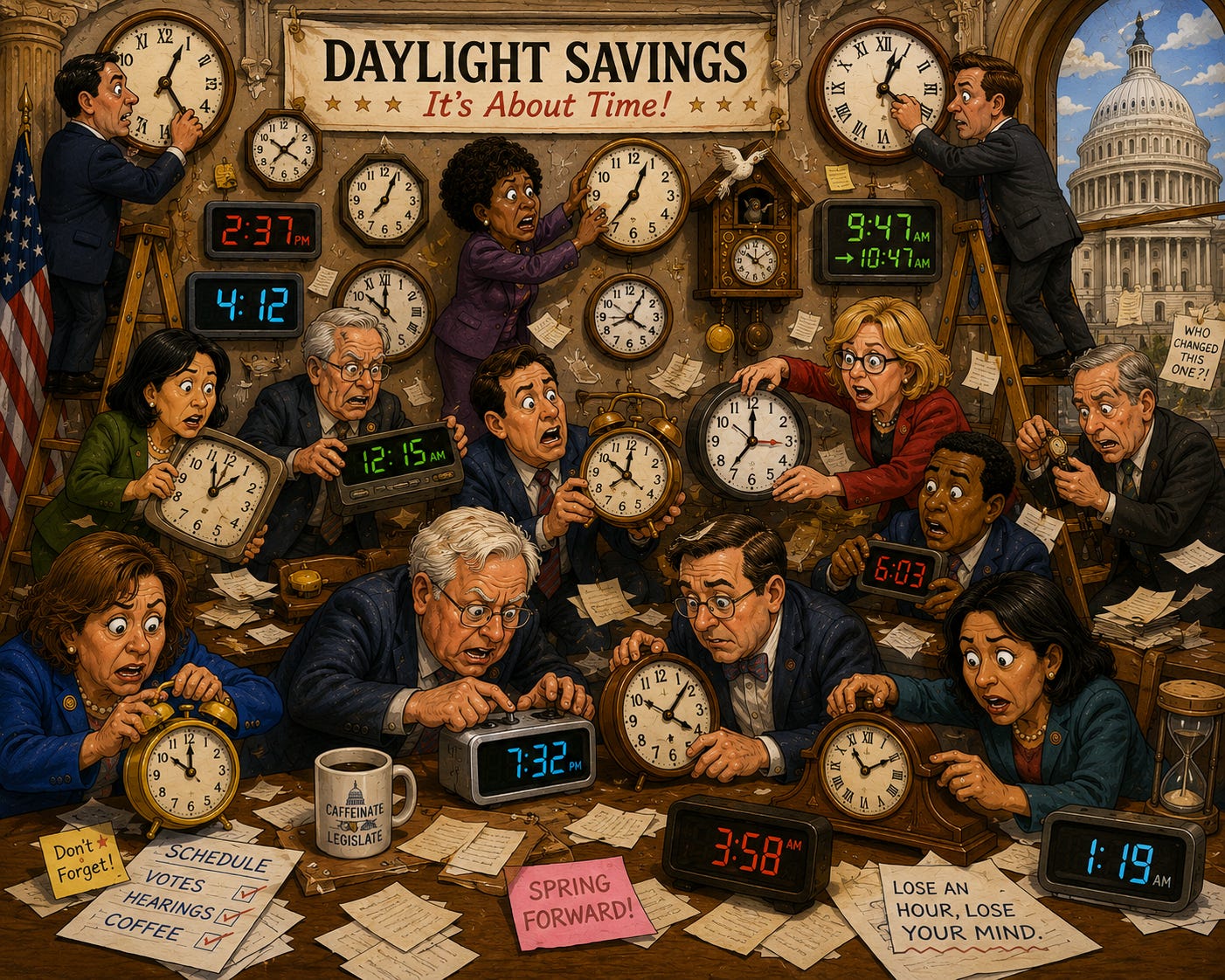
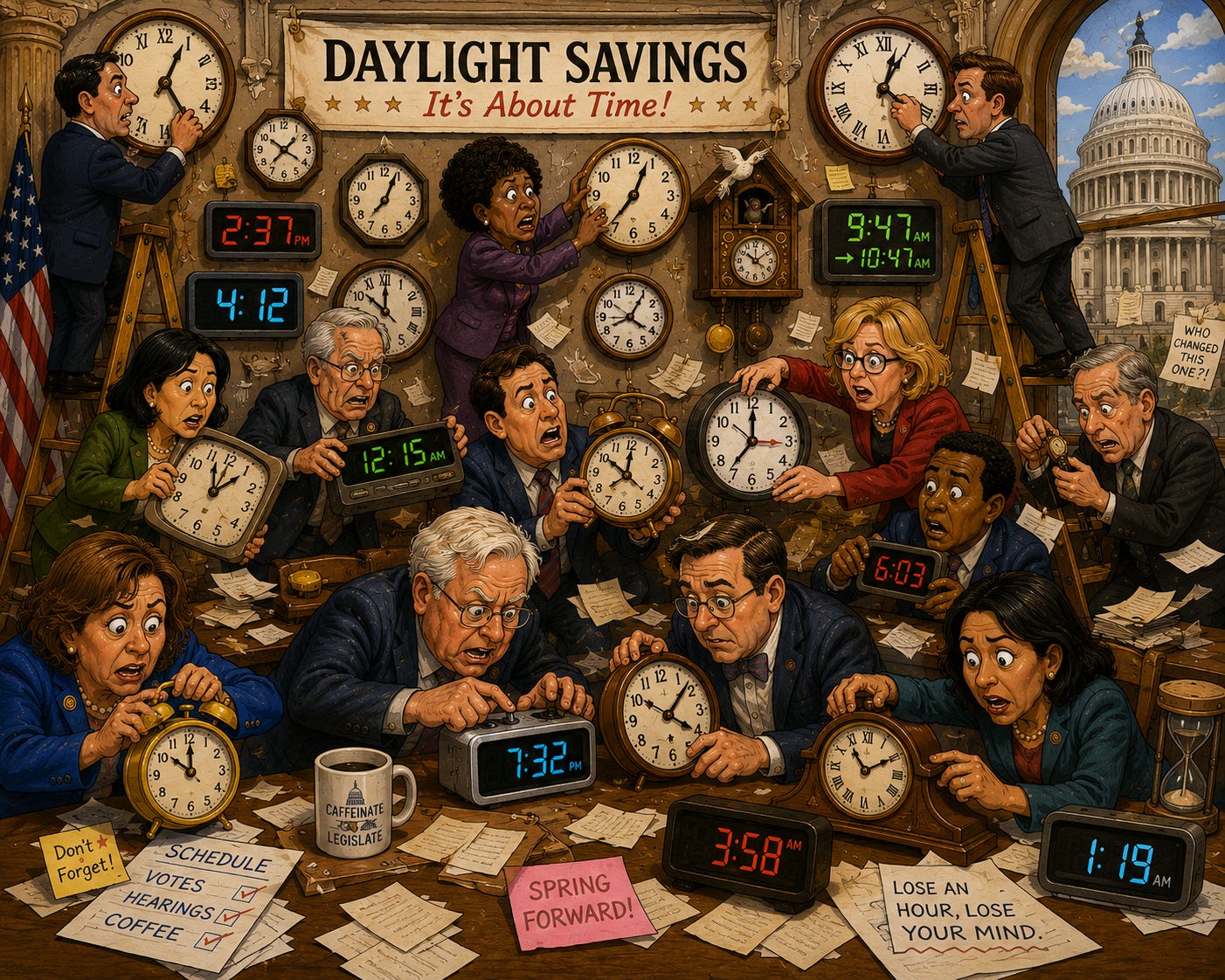
ChatGPT image generation for “a whimsical graphic that shows many members of Congress frantically changing the time on a variety of analog and digital clocks.” Whining. I cannot believe the histrionic terms in which people, even lawmakers and other educated adults, describe the burden of seasonal time change. Sen. Ed Markey calls it “a head-spinning ritual” — if his head spins when the clock changes, maybe that’s a sign he’s too old to do the job of a U.S. Senator — while Sen. Ron Wyden calls it “madness.” In a 2023 editorial advocating permanent daylight saving, the Los Angeles Times Editorial Board wrote, “we set the clocks forward an hour to begin daylight saving time (or increasingly, our smart devices do it automatically) and then spend the next few days slightly discombobulated and wondering why we still practice this odd ritual. By the time the following Sunday rolls around, our disturbed schedules have adjusted and we forget about the week of missed appointments or bad sleep.” Really? The grown, college-educated adults published in the LA Times miss a week of appointments after a time shift that occurs on a weekend and is accounted for automatically by their electronic devices? Have these people never gone on a business trip to a different time zone? How do they cope if they stay up late to watch a sporting event, or have to get up early to catch a flight? When I wrote in defense of seasonal time back in 2021, one reader complained to me that clock changes are “life-ruining” for parents. Sen. James Lankford echoes this sentiment, saying “moms of young children dread the time of year when clocks change.” I don’t have children, but I asked my mother, who raised four children, and she says time changes were not much of a problem — and back in her day, she had to physically change the clocks when the clock changed. There is an epidemic of people in America — voters, alas — who purport to find themselves devastated and aggrieved by the slightest annoyances, especially the ones that have actually gotten less annoying over the decades. At least some of this is fake — some people just like to complain, and are not suffering to the extent they claim to be. But some of it is real, and I believe the increasing unreasonableness of an electorate that wants all its groceries in one bag and also doesn’t want the bag to be heavy is a primary driver behind permanently low approval of politicians in both parties.
I am hopeful that the Senate — as it so often does — will bottle up this piece of House-passed legislation and not allow it to become law. But if that doesn’t happen, the new “permanent” daylight saving time law will reflect a fourth political dysfunction of our time: politicians acting based on what they think polls well, rather than based on what will actually produce results that make voters happy. If a bipartisan cadre of Washington insiders chooses to plunge voters into winter darkness, that will only further erode public confidence in our political elites, and I’m confident the law will be swiftly repealed much like it was in 1974.
Very seriously,
Josh
I’m with you on this. I’m a morning runner (I have to be because of my work schedule) and if this went into effect I’d have to bring a head lamp for most of the year because of this.
They want policies that have an immediate effect on them and don’t care about long term consequences. Also, they hate the opposite: policies that require patience and delayed gratification to see the benefits. Social Security reform, YIMBYism, supply side economic reforms, deficit reduction, are things voters either hate or are not enthused about but are seen as good policy. For those people won’t see any benefit short term or they may see short term pain at first and require time to see any positive effects from them. Foresight is not a strength of populist policy.
There's a part of me that really hopes they do this. I can't think of a more banal, ridiculous, and yet effective "touching the stove" lesson than this.