

Dear readers,
The average voter wants to live an abundant lifestyle that entails a lot of energy consumption. When Abundance came out last year, I had a warning for Democratic politicians: if you make energy expensive, voters will not believe you have delivered abundance. This is the “big-ass truck” Sen. Ruben Gallego has talked about: a lot of men would like to own one, and they’ll need to buy a lot of gasoline to fill it up. Democrats face an electoral penalty because of their commitment to climate policies that make the big-ass truck less available and the gas to drive it less affordable.
Unfortunately, the party has shown little interest in reckoning with this. In Abundance itself, Ezra Klein and Derek Thompson tried to finesse the energy question in a way that was unconvincing, and in elected politics, Democrats have continued to vote for unpopular climate policies, including when every Senate Democrat except Elissa Slotkin stood with the party’s climate-obsessed donors and voted to uphold California’s highly unpopular electric vehicle mandate. It’s a huge drag for a Democratic Party that is supposedly trying to win back working-class voters who had shifted toward the Republicans in recent years.
And then Donald Trump decided to fritter away one of the Republican Party’s biggest political advantages.
Trump used to be a president whose pro-fossil-fuel rhetoric came paired with gasoline prices that were actually low. Prior to the Iran War, the highest monthly average price of a gallon of gasoline recorded during either Trump presidency was $3.34, in September of last year. Gas prices in 2025 were lower than they had been under Joe Biden, and gas prices in Trump’s first term were generally lower than they had been under Obama, never averaging over $3/gallon. As of this Monday, the average gallon price of gasoline in the United States was $4.125, entirely because of the president’s choice to attack Iran with no apparent plan for ending the conflict or preserving the flow of petroleum products. Trump appears to have actually believed that, because the US is a net exporter of crude oil, we would be insulated if an oil shock hit the global market. Now, he’s learned that he was wrong, but he can’t figure out what to do about it.
Democrats’ obsession with climate change and Republicans’ desire for regime change in the Middle East are two versions of the same political problem: Americans’ willingness to bear personal economic cost in the pursuit of policies whose putative benefits will primarily accrue abroad is extremely limited. Trump once appeared to understand this — it informed the way he talked about climate change, foreign aid, foreign wars, and trade policy. It was the basis of the slogan “America First.”
Of course, administration officials would say the war with Iran is about protecting American interests, but they didn’t really argue this (or anything else) in the lead-up to the war. The administration’s choice not to really engage in public diplomacy selling the war either to American voters or foreign allies was norm-breaking, but it was also self-defeating. If Trump wanted foreign navies to help him with opening the Strait of Hormuz, he probably should have made an effort to get countries around the world to feel invested in and consulted about the military operation; and if he wanted American voters to offer him forbearance on spiking gasoline prices, he probably should have tried to convince them the war was worth suffering though.
For that matter, if he were planning to launch a war in the Middle East that was likely to disrupt the global oil trade, he probably should have refilled the Strategic Petroleum Reserve. But he simply is not a guy who plans ahead.
The most remarkable thing for me is that it took so many years for our idiot president to make the specific sort of idiot mistake that stands to make the bottom fall out of his public support. Since the month that Trump launched his first presidential campaign, there has been endless commentary about how Trump has finally fallen into some trap he won’t be able to get out of. That now he’s done, the walls are closing in for real, his voters will abandon him. After years of these claims being wrong over and over, his supporters and his detractors alike came to believe that, no matter what Trump does, he’ll still retain a high floor of political support. But for all the chaos and controversy Trump has caused over the years, he largely kept his promise that he wouldn’t break the economy. Now we will finally see what happens politically when Donald Trump makes choices that wreck Americans’ personal financial situations en masse.1
I believe this is true even if Trump finds some sort of “off-ramp” for the war. Any kind of uneasy truce in the Persian Gulf region, even one with the Strait of Hormuz partially open, will have market participants worrying about future disruptions. It is likely to be persistently riskier to invest in oil infrastructure in the Gulf or to transport oil out. That will reduce volumes and raise prices. Trump’s fetish for fomenting uncertainty and his constantly shifting pronouncements about his intentions for the war also make it hard to offer any kind of certainty to investors and return oil prices to where they were. It’s been particularly strange to watch Trump celebrate the shifting flows of global oil, as tankers arrive to the US Gulf Coast to load up exports to markets that would usually rely on Middle East oil. This is just a manifestation of the global market shift that will make petroleum products less available and more costly for consumers around the world, including here in the US.
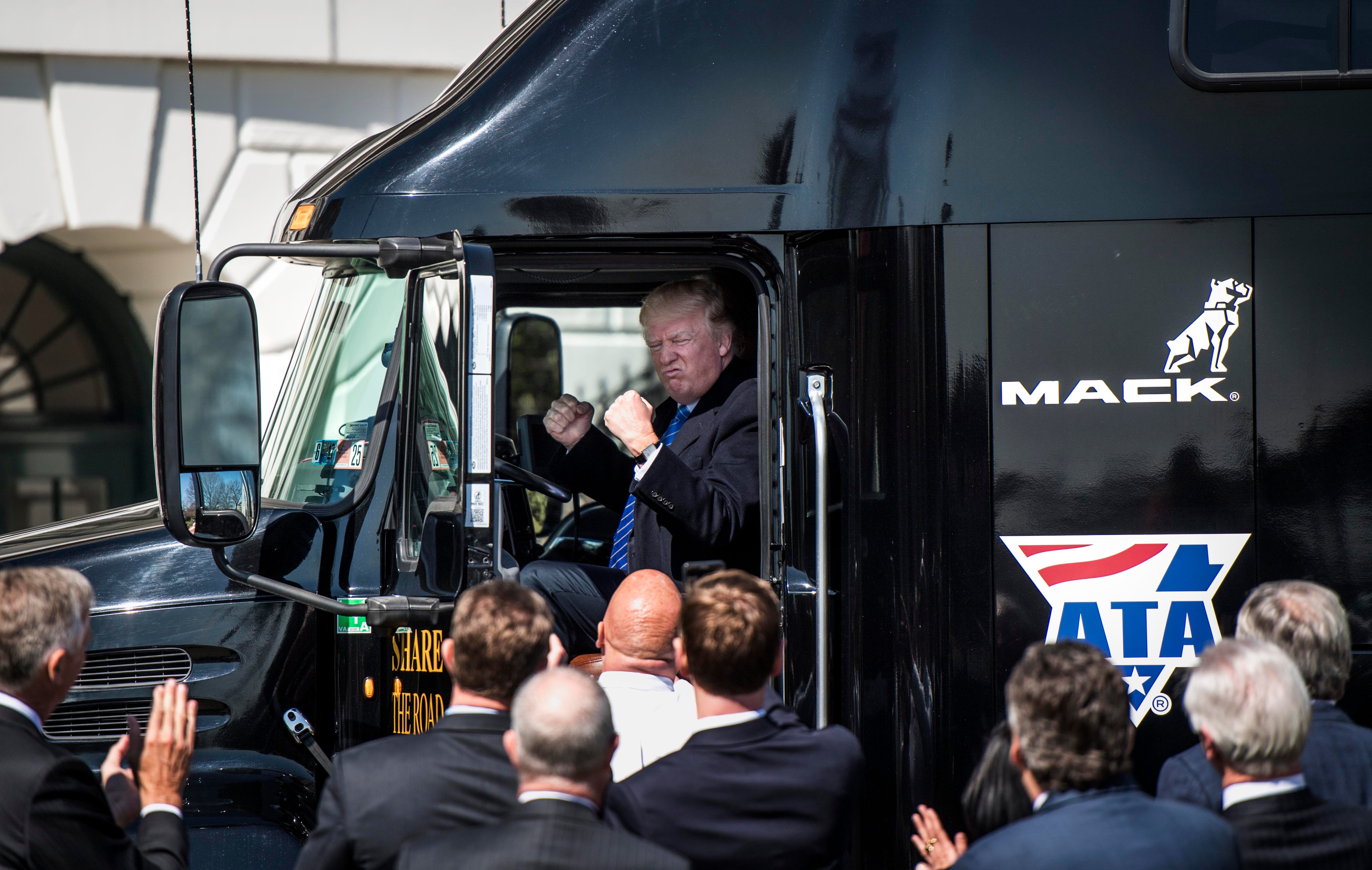
There is also the matter that inflation remained above target even before the war began. The fact that the president did something that directly raised fuel prices also makes it easier to blame him for all kinds of inflation. After all, fuel is a cost component for almost everything. Indeed, this is the president’s other big-ass truck problem: Diesel prices are up almost $2/gallon due to the war, harming the livelihoods of truckers and raising the cost of anything that needs to be shipped by road.
In recent days, Trump’s PR campaign for his own war have gotten sadder and more half-hearted. On Saturday, while his vice president was negotiating with the Iranians, he attended a UFC match in Miami. He has repeatedly attacked the pope. He shared on social media an image of himself as Jesus healing Uncle Sam, and in response to criticism from his own Christian conservative supporters, he claimed he understood the image to make him look like a Red Cross medical doctor. (Does your doctor wear flowing robes and emit light from his hands?)
The widespread criticism of Trump over the Jesus image tells me something interesting. It’s not that this is one of the more offensive things Trump has ever posted, or even that he’s new to blasphemy. It’s that even his fans know the bottom is falling out, that the president has become a lame duck, and that his numbers are only going to get worse from here. Ol’ Donny finally found the jam he can’t wriggle out of. All because he forgot to put America first.
Very seriously,
Josh
Besides the president, the Israelis really ought to understand the world of hurt this war of choice is going to create for them. American public opinion about Israel had already significantly deteriorated before the war, but up until this point, that opinion has mostly been driven by abstract moral feelings about events halfway around the world. Now, the Israeli government has successfully lobbied our president to take actions that financially impoverish average Americans in pursuit of objectives that matter far more for Israel’s interests than our own. This is far more expensive to American consumers than any government aid we have ever provided to Israel. If we experience a year of gasoline over $4, it’s not just public opinion among Democrats that AIPAC is going to need to fret over — Trump may well end up being the last American president to care very much about what an Israeli prime minister wants from him.
I'll keep beating this drum; we really underrate the importance of high interest rates as to why Trump's approval on the economy and Trump's approval generally have gotten so low (and why Biden's remained low even after the worst of the Post pandemic inflation abated).
2008 to 2022 is 14 years and is quite a long time in most people's average lifespan. I know nowadays we talk about ZIRP as only a 2020-2021 phenomenon. But I feel pretty comfortable in saying that we should think of ZIRP as post Great Recession reality for most Americans lived experience. Even if it we weren't in ZIRP circumstances on a technical level, for the average person, we were functionally in a ZIRP environment. This meant low mortgage rates, low interest rates for cars, low interest rates for start ups which is how you end up with the "millennial" subsidy. There is a significant portion of Americans who's entire adult lives were lived in a super low interest rate environment.
It's not just that inflation reached its highest level in 40 years, but interest rates reached it's highest level since 2007. But unlike (to an extent) with Biden (we can debate how much 2021 stimulus contributed to inflation another day), it's really hard to make a case that Trump isn't solely responsible for interest rates being higher than necessary. Between the OBBA (think we underrate the impact this bill had on the 10-year being higher than 4% despite multiple rate cuts), the "Mad King" insanity of his tariff policies and now the "Mad King" manner he is conducting the Iran war, interest rates and borrowing costs remaining high can all be directly attributable to Trump actions. Like honestly, if he had actually spent his second term just playing golf in Mar-A-Lago and literally doing nothing, he is almost certainly at least 5 points more popular in polling thane his now and likely much more.
Between Trump & Netanyahu the number of Own Goals from this mess... impressive.
A quibble on the energy & climate front: the electrification front is less problematic from the PoV economically of being as you and several others frame it as hydrocarbons / IC vs Renenergy/EV than Democrats not grappling with Supply & Demand and having realistic open eyes about the actual current binding constraints which is... permits - grid, grid, grid.
The base economics on electrification are excellent now on modern tehcnology (which is why China has started eating Germany's industrial cake) but one needs a massive upgrading and expansion of the grid, both transmission (long-distance) and distribution (really this is needed no matter what mode of generation one goes for, gas, nuclear, whatever, given data centers, given industrial systems electrification due to the basics of efficiciency - forget the consumer retail view of things)
Regulatory reform - making buildings faster and easier, and also a real national grid like almost all developed economies (really all) have - not the weird 60s era mishmash US has now - that needs a kind of strategic Eisenhower-highways type federal engagement but the economic returns will be brilliant if done.
(I write this from perspective of someone who finances this stuff, industrial scale self-gen, industrial process equip etc)