

Dear readers,
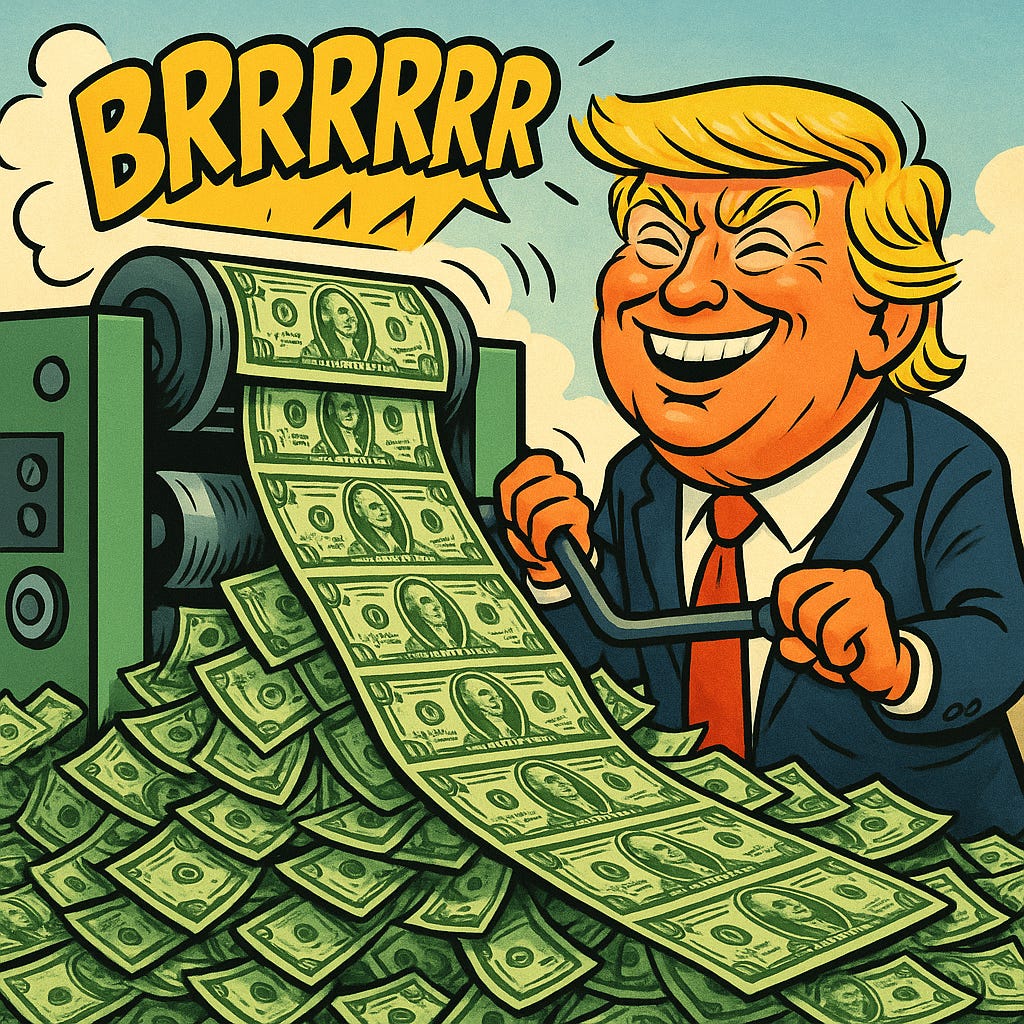
In a banana republic, the president might direct the central bank to inflate in order to finance government spending that would otherwise require onerous borrowing or unpopular taxes. This can produce short-term political benefits because it avoids austerity, but the inflation that results is itself unpopular and can become a serious political problem for the regime.
We are not (yet) a banana republic, and as we have seen in recent years, inflation is a political disaster for the president who presides over it. Despite this, President Trump appears intent on overstimulating the economy: the signature legislative accomplishment of his term, to date, is a huge fiscal expansion, and he now appears intent on remaking the Federal Reserve Board so that it will be willing to set inappropriately low interest rates. His attempt to fire Lisa Cook, a Biden appointee to the Federal Reserve Board, is just the latest escalation in that effort.
Trump likes to be in control and he apparently thinks pushing rates down will cause non-inflationary growth. He identifies as a “low-interest-rate guy” because of his years borrowing to finance real estate development projects. Many of his voters want him to bring back the economy that prevailed during his first term, before COVID, and I’m sure he believes he can do that.
So Trump may attempt to fire and control and strong-arm his way to a 2019 economy, but the problem is that economic circumstances have changed greatly since 2019. The combination of low interest rates and low inflation that prevailed then is not possible in the current environment. If Trump succeeds in getting the Fed to ease interest rates in a way that spikes inflation, he won’t just do long-term damage to the economy. He’ll also do short-term political damage to himself. And again, if inflation spikes, longer-term interest rates are likely to rise — even in spite of Fed-driven reductions in short-term rates — meaning that Trump won't even enjoy the political benefit of lower mortgage rates to offset the pain of higher inflation.
This likelihood — this play-stupid-games, win-stupid-prizes aspect of the Fed fight — may help explain the relatively muted market reaction to the move against Cook, and more broadly to the president’s disregard for Fed independence.
Even though the economic team in this administration has less orthodox views on monetary policy than the Mnuchin-Cohn team that provided steady hands last time around, market participants clearly do not believe that the president’s personnel actions at the Fed are likely to change interest rates nearly as much as he says he wants them to. And, with other threats Trump has made, he and his team have shown themselves to be highly sensitive to moves in the bond market. When the president’s tariff policies caused a swoon in bond prices in April, he moved relatively quickly to significantly pare back the tariffs. And so there could be a self-limiting aspect to the president’s interference with the Fed: if easy money causes higher inflation and higher long-term interest rates, the president may change his mind about how much ease he really wants.
Of course, the markets could be wrong. But if they are, that will become apparent sooner or later, and then they will move in a way that will be seriously politically harmful to the president.
There are two political challenges here for Democrats in responding to this. One is that they need to warn voters about a risk that hasn’t yet come to fruition: the president’s actions are irresponsible and may spike inflation, but inflation has so far ticked up only modestly in recent months. The other is that the last Democratic administration overstimulated the economy and presided over significantly higher inflation than prevails now.
Still, the available message to voters is fairly simple: this is irresponsible, especially in combination with the president’s tax cuts for the rich that ballooned the budget deficit, and it stands to make everything you buy more expensive. Senate Minority Leader Chuck Schumer hit this messaging pretty well in his statement today. Voters do not care about Fed independence in the abstract, but this message will become politically potent if and when inflation materializes.
The message Democrats should not be leaning on is the one House Minority Leader Hakeem Jeffries chose: that Dr. Lisa Cook, a “distinguished public servant,” is a black woman being treated unfairly. The biggest problem here isn’t even the pointless invocation of race. It’s that Jeffries doesn’t even mention the economic risks posed by Trump’s action. And it’s also tone-deaf for him to frame this issue around whether we’re being fair to one of the elite people who governs our economy. I think Cook has done a good job as a Fed governor, but ultimately what happens to her or any other Fed board member isn’t important to voters — what’s important is what happens to the American consumer. And I don’t think those consumers are very interested in hearing about the importance of having sufficient respect for the experts with Ph.D.s who make our public policies.
Very seriously,
Josh
It’s a banana republic Josh. How much could it possibly cost? $10?
It does seem odd to me that the market moved so much during liberation day but not since then. I wonder if the TACO concept is just motivated reasoning to block out the uncomfortable updates since then.