

Dear readers,
I moved from New York to Washington, D.C. in the spring of 2008, initially staying in a temporary sublet while I figured out where I might live more permanently. At the time, a lot of young professionals like me were moving to gentrifying-but-still-sketchy neighborhoods north of downtown, like Shaw, Columbia Heights, and Mount Pleasant. And I was struck by how many of those young professionals talked about being victims of crime: they got mugged, they got assaulted, their cars were broken into. This wasn’t something I often heard about while I was living in Manhattan and Queens.
Then, in July 2008, the journalist Brian Beutler was shot during an attempted mugging late at night in Adams Morgan not far from Columbia Heights. I didn’t know Brian at the time — I would meet him later — but a lot of the bloggers I read regularly were friends with him, and they had alarming things to say. Ezra Klein, for example, wrote that about half his friends in the District had been mugged. The commentary on Beutler’s shooting was what led me to say, screw it, I’m going to find an apartment west of Rock Creek Park, where I won’t have to worry about being a victim of a violent crime. I moved later that summer to Woodley Park, a quiet and leafy1 neighborhood near the National Zoo, and I stayed there until I moved back to New York in 2010.
The violent crime situation in D.C. improved after 2008, with murders reaching their lowest level in decades by 2012. Then it got worse, and then it got a lot worse, and then it got somewhat better again. After all that change, the District’s murder rate has ended up about where it was when I moved there: the city suffered 187 homicides in 2024, compared to 186 in 2008. All along, D.C.’s murder rate, and its violent crime rate more broadly, have been far higher than those of other coastal superstar cities like New York, Boston, San Francisco and Los Angeles. New York, with approximately 12 times as many residents as Washington, had 377 homicides in 2024, meaning New York’s murder rate was just one-sixth of Washington’s. Boston, with approximately the same population as Washington, had just 23 homicides in 2024.
So the president is broadly correct to identify Washington as a city facing a public safety crisis. The apparent proximate driver of the president’s intervention — federalizing the District’s police department, diverting federal law enforcement officials to patrol the capital and activating the National Guard — is that former DOGE staffer Edward Coristine, the 19-year-old better known as “Big Balls,” was attacked by a group of adolescents in an attempted carjacking near Dupont Circle. I’ve seen some conservative commentators snarking that white liberals in Washington don’t care about the city’s crime problem because they’re ensconced in safe neighborhoods, but the attack on Coristine reflects the same reality that Beutler’s shooting did 17 years ago: Washington’s elevated violent crime isn’t just a problem for poor black residents east of the Anacostia River, but can strike well within the city’s downtown core, including expensive neighborhoods like Dupont.
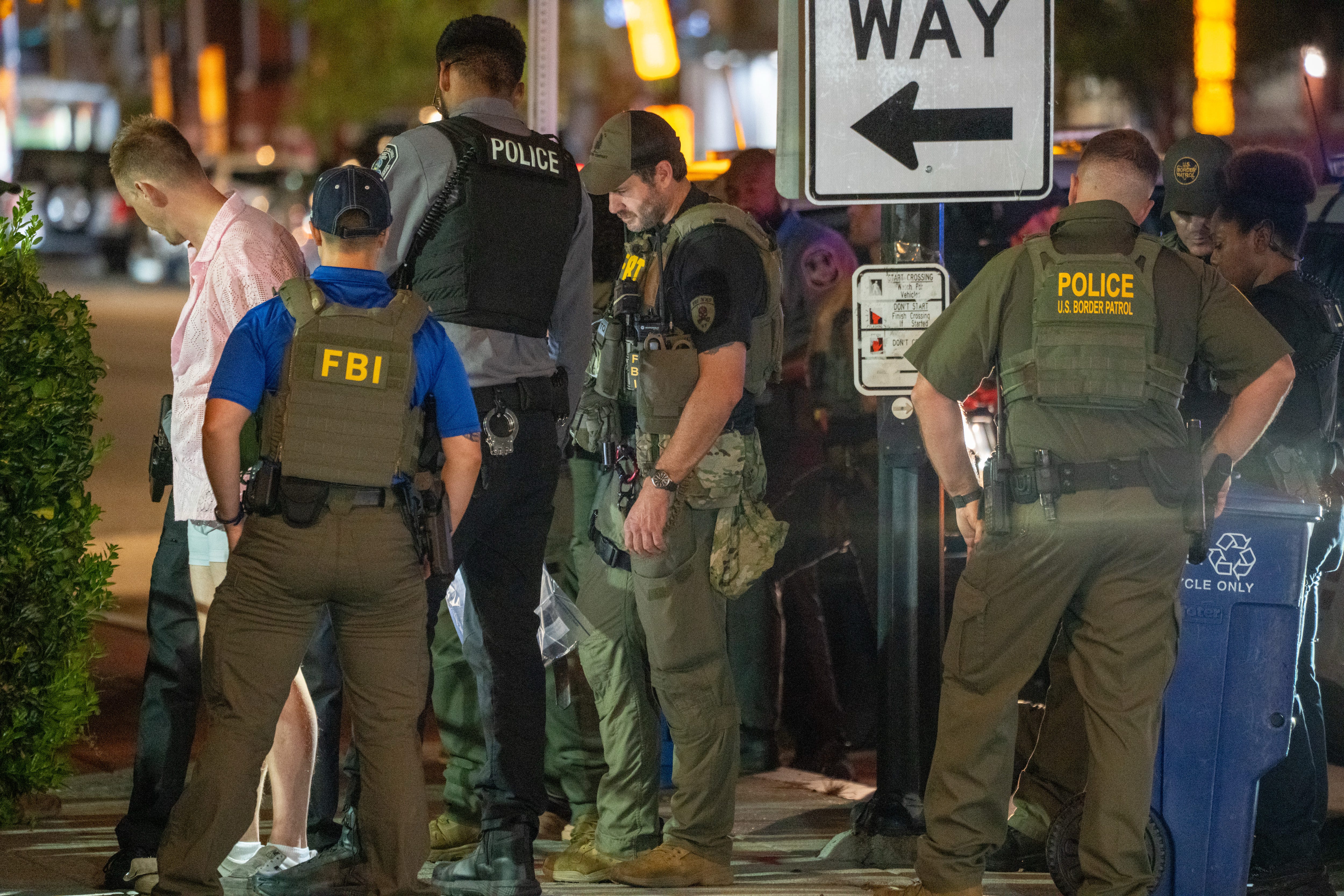
Now, it is true that the president’s showy intervention this week — with FBI, ATF and DEA personnel doing foot patrols in neighborhoods with relatively low crime rates, like Georgetown — is unlikely to help matters much. It also constitutes a diversion of federal law enforcement resources that are needed for other threats to public safety, and it’s an inappropriate use of the National Guard, since the city is not facing civil unrest. But it’s not good enough for Democrats to say Trump’s plan won’t work. They need their own argument for how they would make us safer. And they definitely shouldn’t be acting as if Trump is making the problem up, or as if the local problems of Washington, D.C. are none of his business.
Unfortunately, that’s what a lot of them are doing.
“The crime scene in D.C. most damaging to everyday Americans is at 1600 Pennsylvania Ave.,” says minority leader Hakeem Jeffries. “Violent crime in Washington is at a 30-year low.”
“Get lost,” he adds.
The 30-year-low claim is dubious — it’s based on statistics that show a sharp decline in assaults with dangerous weapons and robberies in 2024. But crimes like these don’t always get reported, and there is an ongoing internal investigation into whether leaders in D.C.’s police department have been systematically downgrading reported assaults and robberies in order to show falling crime in those categories. A commander in the department has been placed on leave pending that investigation. Homicides, which are more reliably reported than assaults and robberies, are down significantly from their recent peak in 2023 but are nowhere near 30-year lows. In fact, there have already been more homicides in D.C. this year (99) than there were in the entirety of 2012 (88).
As someone who would like the public to have confidence in high-quality government statistics that are under unfair attack, I’d urge both Democrats and journalists to be careful about insisting on lower-quality statistics like the “30-year low” that many listeners will find implausible and that might well be wrong.
Besides, when Democrats nitpick whether crime in Washington has been getting better or worse lately, they miss the larger point: violent crime in Washington is (and has been) alarmingly prevalent all along, reflecting a joint failure by the local and federal governments that share responsibility for public safety and crime prevention in the city. The issue is real, and it has relevance for federal politics because the federal government is headquartered in the District, and because the Constitution gives the federal government extensive authority over the management of the District.
But the “get lost” part of Jeffries’s statement is what bothers me most. Democrats’ focus on proceduralism — that is, an insistence that Washington, D.C. should be free to fuck up its own shit without meddling from the federal government — is a loser message that fails to address voters’ reasonable concerns about crime. It presents voters a choice between a party that’s trying something that probably won’t work and a party that is in denial about — or worse, willing to tolerate — an abnormally high crime rate. It commits national Democrats to owning the failures of the consistently mediocre public officials who have won elections in the District — officials who, for example, dithered for years over obtaining re-certification of the District’s crime lab, a span of years when prosecutions and convictions became much harder to obtain because police and prosecutors could not rely on the crime lab to marshal forensic evidence.
So, what should Democrats say instead? They should say the federal government needs to do more to make Washington safer — just not what Trump is doing. A lot of the problems with criminal justice in Washington lie in the federal courts where the city’s major prosecutions happen. There are too many judicial vacancies, and the U.S. Attorney’s office has been declining too many prosecutions, meaning too many criminals go free and too many miscreants believe they will get away with crime. Fixing those prosecutorial problems is a federal responsibility — Democrats should say that if Trump wants to be tough on crime, he can start by making sure prosecutors are bringing enough cases and there are enough judges to hear them.
There’s more federal change Democrats can call for. A lot of the apparent disorder in the District occurs in neighborhood parks that are maintained (poorly) by the National Park Service — the NPS doesn’t just manage the famous green spaces in the monumental core but also hundreds of tiny parks and squares, many of which are in shabby condition. Democrats can call for the federal government to either devote more resources to keeping those spaces clean and safe, or hand them back to the city to manage itself. (This would be something of a point of agreement with the president, who has ordered the removal of homeless encampments and also says his expertise as a golf course operator gives him ideas about how to fix the subpar grass across the city’s federally run parks.) Democrats should also call on Republicans to stop playing games with the District’s budget, depriving the city of the ability to use its own revenues to fund services like policing. And Democrats can also align themselves with some conservatives who have argued the federal government, given its valid interest in public safety in the capital, should send the city money to hire more police. Back in the Clinton administration, federal funding to expand local police headcounts was a popular tough-on-crime initiative for Democrats — why not bring it back?
Democrats should also emphasize the need for permanent solutions rather than showy-but-temporary measures. The District needs a bigger police force and it needs more effective courts. The country as a whole needs the FBI and the DEA doing the jobs that federal taxpayers expect from them — they shouldn’t be pulled off their primary work to do foot patrols in Georgetown. But that needs to be a two-part argument: you can say Trump’s actions make the government less effective and are all for show, but you also need to say what better thing you would do instead.
Of course, crime in D.C. specifically is not going to be a major motivating issue for voters all around the country. But broadly, crime matters to voters. So when the president moves crime in D.C. up to the top of the national agenda, Democrats should not be saying the problem is made up and the federal government should butt out — that makes them the party that doesn’t want to do something about crime. Instead, they should offer a plan that’s better than the president’s plan. Given how insufficient the president’s plan is, that shouldn't be as difficult as it appears to be.
Very seriously,
Josh
Ward 3, which consists of Woodley Park and other affluent neighborhoods west of the park, is kind of the Upper East Side of Washington. I make this comparison advisedly: like the Upper East Side, it has a longstanding reputation as a safe and tony part of the city; and like the Upper East Side, it’s a little remote and a little uncool, and apartments there are quite a bit more affordable than those in close-in fancy neighborhoods like Georgetown or Dupont Circle (or Chelsea or SoHo). Contra Erick Erickson, our journalist class largely doesn’t live in Ward 3 and isn’t particularly insulated from the city’s crime problems — many of them live farther south and east within the District, and to this day they seem to have a lot more direct experience with crime than my peers in New York.
I live in DC’s third ward with my family. Josh makes some fair points. A big issue he overlooks is the ridiculous council members we elect. Trayon White was expelled by the council for taking a bribe, which was caught on camera. He was reelected to the council by his ward’s voters.
We exist in a middle ground where we have home rule but can have the feds over rule us when we get too wild. This also happened in the Biden administration with a bill about reforming the penalties for crimes. It reminds me of student council elections where they promise to serve pizza every day or something.
I wish we had self government like the rest of the country, but I’m sometimes relieved we don’t.
Urban liberals (of which I am one) do have a longstanding tendency to pooh-pooh legitimate concerns about crime and disorder in cities. I’m not sure what it is. Part of it is probably that young white liberals who move to big cities view themselves as edgy/cool for being able to “handle” the grittiness of urban life unlike their conservative counterparts from their hometown. Part of it is that right-wing complaints about urban crime are evergreen and will occur regardless of the year or actual level of crime in the city or neighborhood in question, which probably makes liberals discount their concerns— for instance I was told by relatives in 2015 that they were too scared to visit crime-ridden manhattan, which at the time was experiencing some of the lowest levels of violent crime in decades. Part of it is also probably that conservative complaints about crime are often tinged with coded racism or prejudice about poor people. But whatever it is, it does result in a lot of city residents tolerating levels of disorder and lack of safety that, objectively, should not be acceptable.