

Dear readers,
One issue that has helped Democrats in this year’s elections is public dissatisfaction with electricity prices. Electricity prices in September were 5.1% higher than one year earlier, and the upward march of electricity costs under Donald Trump extends an ongoing trend from the Biden administration. Consumer electricity prices rose by 37.5% from January 2020 to September of this year, outpacing general CPI inflation, which totaled 25.2% over the same period. The cost of piped natural gas has risen even more sharply over that time — 49.3%.
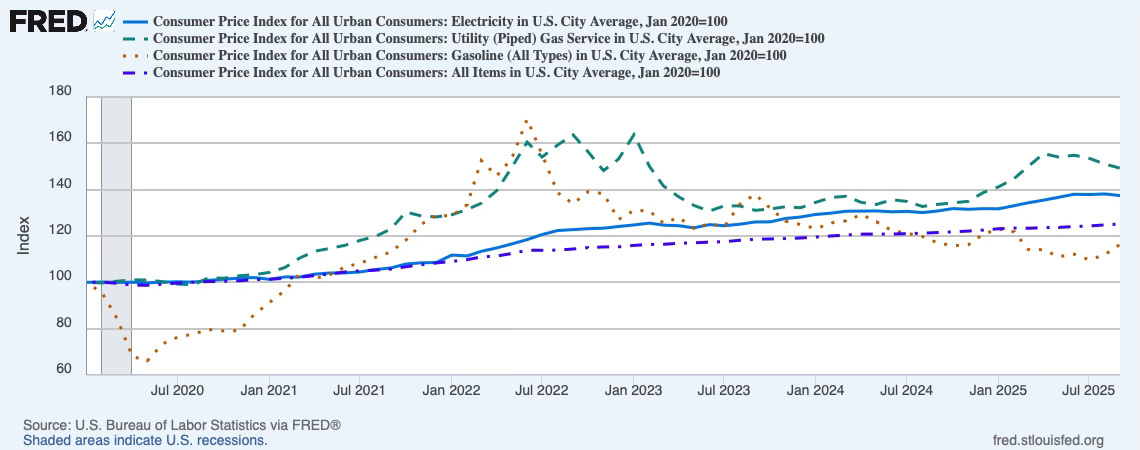
When you’re out of power, inflation is a good issue for you, and Democrats have capitalized on President Trump’s failure to actually make life more affordable. But over the long run, Republicans have an advantage on energy as a political issue, because they actually implement policies that make energy cheaper.
States run by Republicans tend to have much cheaper electricity than those run by Democrats: while consumers paid a national average of $0.18 per kilowatt hour for electricity in September, the average rate was $0.30 in New England, $0.24 in the Mid-Atlantic, and $0.32 in California. As a party, we should be nervous about the increasing salience of this issue, because we are worse than Republicans at delivering the cheap electricity that consumers want.
To gain a long-run advantage on the energy issue, Democrats need to commit to providing energy that is cheap and abundant. That’s going to require changing the way we govern, making it easier to produce energy and deliver it to consumers. And it’s going to mean scaling back policies that intentionally raise the cost of energy in pursuit of carbon emissions reduction.
Consider the situation in Connecticut, which at $0.30 per kilowatt hour in September had the second-highest electricity prices in the Lower 48, trailing only California. In theory, a densely populated state like Connecticut should have relatively cheap electricity, because you don’t need as much length of transmission line per customer. But in practice, the densely populated states of the northeast tend to have expensive electricity because they have not built enough energy generation and transmission infrastructure to meet demand.
Here are some drivers of Connecticut’s high electricity costs, as identified by Noah Kaufman in a recent report for the Center on Global Energy Policy at Columbia:
Limited gas pipeline capacity into New England causes sharply spiking costs for gas-fired electrical plants in winter.
A renewable portfolio standard pushes utilities toward relatively expensive sources of power generation, while a requirement to purchase cap-and-trade permits acts effectively like a tax on electricity, and expensive incentives encouraging the installation of rooftop solar are effectively borne by the rest of ratepayers who don’t have rooftop solar. Together, these three green policies account for somewhere between 2 and 3 cents of Connecticut’s $0.30-per-kWh residential electricity price — or about 20% of the extent to which Connecticut’s costs exceed the national average.
Efforts to add capacity have foundered. Offshore wind was supposed to be the core of the state’s move toward renewable energy sources, but these projects were already behind schedule and over budget even before the Trump administration started trying to cancel them, and they are unlikely to be price-competitive even if permitted. Meanwhile, proposals to add gas pipeline and long-distance electrical-transmission capacity into Connecticut have faced political and judicial delays.
Kaufman has a variety of suggestions for how Connecticut can provide more abundant, cheaper electricity. These include encouraging more installations of grid-scale solar generation (more cost-effective than rooftop solar), entering into a contract to keep the Millstone Nuclear Power Station operating past 2029, reducing the price of cap-and-trade permits, and adding capacity for electrical transmission from Canada and piped natural gas from Pennsylvania. Note that this menu includes many kinds of energy sources: gas, nuclear, solar, and hydro (which is how Canadian electricity is made). If Democrats instead follow Bharat Ramamurti’s advice to focus their efforts on “solar, wind and other clean-energy”1 investments, it will limit how competitive and effective they can be on electricity costs. And if they accede to demands from groups like the League of Conservation Voters to refrain from easing permitting restrictions under the National Environmental Policy Act, then states like Connecticut are unlikely to get the pipelines and transmission lines they need to cut the retail price of electricity.
Some Democrats are demonstrating that they know an agenda aimed at containing energy costs must include an all-of-the-above approach. Last month, New York Governor Kathy Hochul approved the construction of a new gas pipeline to Long Island, which faces gas-capacity constraints similar to Connecticut, over the objections of progressives in her party. She’s also overseeing the construction of a major electrical transmission line to bring Quebec hydropower to the New York City area — a project that divides the smarter wing of the environmental movement from its dumber wing — and has an initiative to add new nuclear generation capacity in the state. Her administration constitutes a major improvement from Andrew Cuomo’s — Cuomo foolishly closed the Indian Point Energy Center, the nuclear power plant that had been New York City’s primary source of low-carbon electricity.2
A new law passed by Democrats in Illinois this fall also reflects an all-of-the-above approach to electricity abundance. Lawmakers in the state approved major subsidies for battery storage that are intended to bolster renewable energy development, while also repealing the state’s moratorium on new nuclear power plants, granting the state’s utility commission authority to waive deadlines the legislature previously set for retiring carbon-emitting plants, and reducing the ability of local jurisdictions to impede energy projects.
At the federal level, Democrats should buck the environmental groups and seek bipartisan permitting reforms that would make it easier for states to add needed pipelines, transmission lines, and power plants. I wrote a few months ago about the potential of such efforts in Congress, and while we’re not exactly at a high water mark for bipartisanship in Washington, there have been developments over the last year that should make both parties more eager for a deal. The Trump administration’s capricious cancellation of renewable projects should make Democrats eager for a deal that restricts the ability of the executive branch to cancel energy projects once they are approved. And Republicans, who used to view permitting reforms to ease interstate electrical transmission as primarily a concern for electrification-happy Democrats, are more attuned to the need for more electrical capacity because of consumer dissatisfaction with rising prices and the need for data centers to fuel the AI boom.
To the extent Democrats have a political opportunity here, it’s because of the ways the Trump administration is screwing up on energy policy. By canceling wind and solar projects for culture-war reasons, the president is essentially begging voters to blame him for rising electricity prices. He is damaging Republicans’ brand as the party of abundant energy. But to best capitalize, Democrats have to actually fight to increase the abundance of energy and reduce its cost, and to shed our image as the party that makes energy more expensive.
To see the benefits that a pivot away from high-cost energy policies can produce for a left-of-center political party, look north to Canada. Liberal Canadian Prime Minster Mark Carney was all smiles last week with Danielle Smith, the conservative premier of Alberta, as the two leaders made a joint announcement about plans to better develop and export the province’s fossil fuel resources. The big headline was Carney’s support for a pipeline to carry Alberta crude oil to a Pacific Ocean port for export to Asia. This would reduce Canada’s reliance on the United States as an oil export market, allowing the country to get higher prices for its oil and be less exposed to our country’s tariff policy whims. But pipeline proposals have long faced opposition from environmental groups and from the coastal provinces they would need to pass through.
Just about a year ago, the Canadian Liberals — led by the very unpopular Justin Trudeau — appeared to be headed for a landslide defeat at the hands of the Conservatives. It helped Liberal fortunes that Trudeau stepped down so Carney could take over as prime minister, and it helped that Trump emerged as a unifying villain for Canadians across the political spectrum. But a major reason the leadership change helped was that Carney immediately canceled one of Trudeau’s most unpopular policies: a carbon tax. Carney stole the Conservatives’ best issue — a pledge to “axe the tax” — and led his party to a come-from-behind victory in an election last April. The Alberta deal represents his efforts to reposition his party away from its politically toxic positioning on energy, over the objections of certain elements in his coalition.
Progressives say the Democratic Party needs to be more economically populist, and everybody across the political spectrum wants to talk about how they are promoting affordability. But there can be no effective economic populism without a commitment to affordable energy — and energy needs to be more abundantly produced if it’s going to be more affordable. Over the next few years, we will see which Democratic leaders are willing to stand up to the de-growth elements in the environmental movement and support true energy abundance — and which ones will only pay lip service to “affordability” while prioritizing the interests of climate-obsessed party donors who actually want energy to be more expensive.
Very seriously,
Josh
Note that the use of the vague term “other clean energy” elides important disputes within the Democratic Party coalition about whether nuclear and hydro constitute clean energy, and also excludes the promotion of natural gas resources, which Democrats embraced in our more politically successful days under the leadership of Barack Obama.
Three new power plants, powered by natural gas, fill the void left by the Indian Point shuttering, which worked against Cuomo’s goal of decreasing New York’s reliance on fossil fuels, while also making New Yorkers more susceptible to swings in natural gas prices.
Fantastic summary , but I have my doubts that any pivot towards more affordable energy which means both the embrace fossil fuels , particularly nat gas, and also nuclear including SMR’s will not become an incredibly divisive debate between the few Dems still embracing realism and the progressive wing which seems to increasingly dominate the party.
Another cost of living issue is the price of gasoline, once again red states on balance are much more consumer friendly on this issue than blue states. Drill Baby Drill is anathema to most Dem leaders who seem to still belief that any increased use of carbon will lead to extreme global warming and the preposterous idea that it will thus lead to the end of life on earth as we know it today.
Nice piece that also confirms two of my hot takes: Kathy Hochul is a good governor and Canadian Liberals are way more right-leaning/“neoliberal” than Americans realize